Compare the tone of Artificial Intelligence (AI) articles in healthcare from a year ago to today, and you’d think they were talking about entirely different technologies. Last summer, healthcare executives were bold in their embrace of AI. The enthusiasm was contagious, with use case after use case painting a future of limitless potential.
But the narrative has shifted. The smoke has cleared, the hype has died down and now comes the hard part: implementation. Does this mean AI has failed to deliver on its promise? Not at all. In fact, this transition is expected. As Gartner describes in its hype cycle, most new technologies fall into a “trough of disillusionment” after the initial buzz fades. It’s a sign that organizations are starting to get serious — moving from experimentation to real, measurable outcomes.
The truth is, AI isn’t new to health plan operations. It’s been quietly working in the background for years, often in backend processes far from the member’s view. What’s changing now is the breadth and visibility of AI’s role especially as health plans prepare for a complex Open Enrollment (OE) season ahead. From member acquisition to guided plan selection, AI is poised to play a transformative role in both operations and the member experience.
Member Acquisition and Marketing
AI’s impact is already being felt in the earliest stages of the member journey: acquisition and marketing. As health plans prepare for OE and the Annual Enrollment Period (AEP), they’re facing more uncertainty than ever. Between the expiration of expanded subsidies, states transitioning to State-Based Marketplaces (SBMs), and shifting redetermination requirements, the need for clear communication and efficient processes has never been greater.
This is where AI shines. Used strategically, it can help reduce administrative burdens while supporting tailored outreach efforts. Brendan McLoughlin, President of e123, emphasized the potential of personalized marketing powered by AI to address the specific concerns of various member segments. With so much confusion likely among both new and returning enrollees, personalized, AI-generated content can be a game-changer.
Shopping with Guided Plan Selection
AI is also transforming how people shop for health coverage. Tools that use AI to support guided plan selection are gaining traction, and even brokers and agents — traditionally wary of automation — are beginning to see these tools as complementary aids rather than threats.
This assistance is particularly critical in the ACA and Medicare Advantage markets, where choice can be overwhelming. During the most recent ACA enrollment season, the average consumer had around 100 plan options to choose from. In Medicare Advantage, the average enrollee had access to 43 plans in 2024 — double what was available just a few years ago, according to KFF.
One standout example is Alight, a cloud-based HR services provider. According to the company, 95% of employers they serve now use AI tools like virtual assistants to help employees select benefits during OE. This trend points to broader adoption and increasing trust in AI-driven tools to guide consumer decision-making.
This use case becomes even more relevant with the growing popularity of Individual Coverage Health Reimbursement Arrangements (ICHRA). Employees in ICHRA-funded arrangements can choose from the full catalog of Marketplace plans, which dramatically increases their choice—but also their confusion. It’s still unclear whether the responsibility for guiding these employees will fall to employers, their BenTech partners, or even the health plans.
What is clear, though, is that consistency across touchpoints is crucial. AI can help ensure that messaging and decision support tools align across platforms—whether they’re delivered by an employer portal, a broker, or a health plan website. In a model where these stakeholders are more interconnected than ever, AI will be essential for integration and cohesion, helping to avoid confusion while elevating the member experience.
And as AI tools become more advanced, we’ll also need to rethink how brokers and agents interact with them. Rather than being replaced, they’ll increasingly serve as AI-assisted advisors, offering a hybrid shopping experience that combines human expertise with machine efficiency.
Billing, Payment, and Recon
One area that may prove especially challenging in the next few years is member billing and premium payment processing. With projected changes to subsidy structures, many health plans are relying on actuaries to produce multiple rate forecasts for OE 2026. That means health plans must tread carefully with member communications—balancing timely updates with the need for accuracy.
AI can play a critical role here by enabling faster, more flexible adjustments to communication templates and billing workflows. For example, health plans can use AI to:
- Improve invoice quality by analyzing patterns across past transactions and flagging anomalies, reducing the need for manual reviews.
- Automate reconciliation between enrollment data and billing systems, minimizing gaps and boosting financial accuracy.
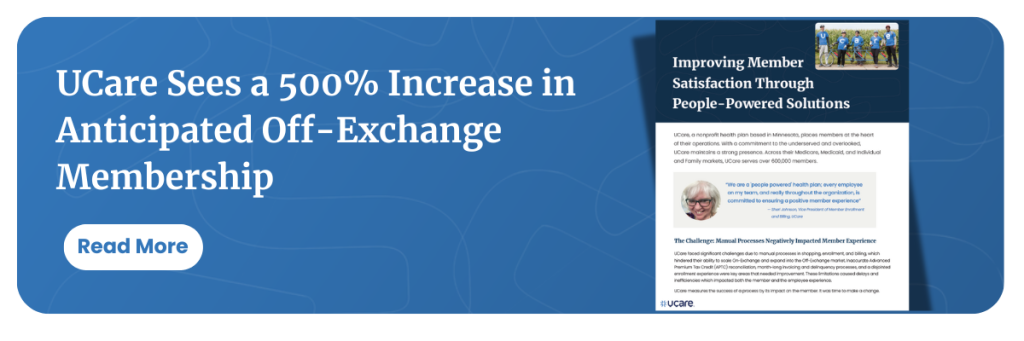
Softheon recently helped a health plan increase its APTC reconciliation accuracy by 2.5%, resulting in more than $2 million in additional reimbursement revenue. These types of AI-driven improvements offer real administrative savings at a time when ACA margins are increasingly under pressure. Read the full story.
Backend Process Automation
For many health plans, 2025 will be the year of operational streamlining. Administrative costs continue to rise, and health plans are under pressure to do more with less—without compromising member experience. AI and machine learning can help close that gap. As Florida Blue noted, “Thanks to the integration of AI, automating manual tasks and leveraging machine learning algorithms has helped health insurers reduce errors, improve data accuracy, and strengthen customer experience.”
The 2023 EY-Parthenon and KLAS Research Payer Tech Study reinforces this trend. It found that:
- 45% of health payers expect AI-driven investment in areas like risk adjustment, condition management, and payment integrity to be “highly significant.”
This focus points to AI’s growing role not just in cutting costs, but also in enhancing accuracy, compliance, and member engagement. Tom Cohen, EVP of Healthcare Solutions at Softheon, shared how AI is already improving internal operations, “We’ve been rolling out generative AI capabilities to bring efficiency to our internal teams by synthesizing all our regulatory and solution-based data. This initiative not only improves our internal operations but also offers our partnered health plans greater accessibility to Softheon’s process documentation through a chatbot interface.”
This type of initiative demonstrates how internal AI applications can improve external outcomes — freeing up staff resources and enabling faster, more informed responses to member needs.
What’s Holding AI Back?
Despite the clear use cases, AI adoption isn’t plug-and-play. Rolling out AI initiatives takes more than enthusiasm — It takes dedicated resources, organizational alignment, and a strong data foundation.
The biggest barrier? A lack of unified data infrastructure across the healthcare ecosystem. AI depends on clean, consistent, and compliant data to be effective—and that’s still a challenge for many health plans. To unlock the full value of AI, plans need to prioritize three areas: data governance, AI regulation, and trusted partnerships.
1. Robust Data Governance
AI relies on sensitive health information, and trust is non-negotiable. Health plans must adopt clear, comprehensive data governance frameworks to meet HIPAA requirements and uphold member privacy. This includes:
-
- Transparent policies on how data is collected, processed, and used
- Practices like encryption, de-identification, and access controls
2. AI Regulation and Federal Support
The regulatory landscape is beginning to catch up. National-level investments like the Stargate AI venture, backed by President Donald Trump and major tech leaders, signal growing support for domestic AI infrastructure. Though still early, efforts like this may pave the way for more healthcare-specific innovations — and funding.
3. Collaboration with Trusted Technology Partners
Many health plans are accelerating AI adoption through collaboration with proven vendors. Working with partners that understand regulatory nuances and commit to ethical AI development helps reduce risk—and allows plans to scale faster and smarter.
AI isn’t here to replace people — it’s here to empower teams, make smarter decisions, and deliver a better experience for members. As health plans prepare for the next wave of industry transformation, AI will be a critical piece of the solution.